

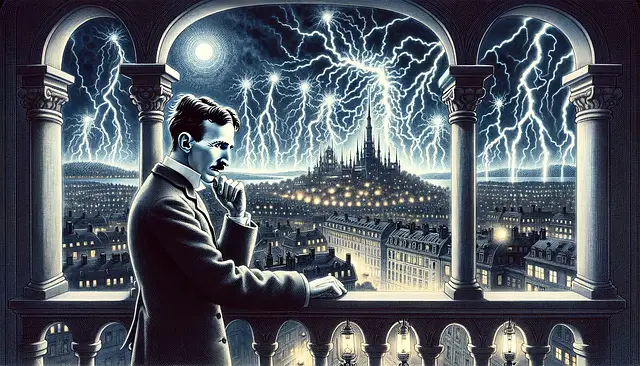
If there is one great inventor widely known for practicing semen retention, it is Nikola Tesla. He viewed marriage as an impediment to making great inventions. His remark, “I do not think you can name many great inventions that have been made by married men”, proves that he believed marriage could prevent him from devoting more time and energy to scientific inventions. It also implies that he knew that the responsibilities of marriage could prevent him from cultivating the extraordinary intelligence needed for great inventions.
Although many claim that he was born a genius, this quote implies that Nikola Tesla believed that extraordinary intelligence is not only a matter of natural talent but also of disciplined accumulation and transmutation of one’s sexual energy. He perceived marriage as a potential dilution of the intensity required to cultivate the level of intellectual clarity that leads to great inventions.
By asking others to name great married inventors, Tesla was arguing that the evidence supported his position. He believed that transformative innovation required an undivided mind that is free from the compromises present in sharing one’s life with another person. The responsibilities of supporting a family, in his view, are incompatible with the intensive concentration that produces revolutionary ideas.
Tesla’s quote exposes an understanding that great inventions require a particular quality of mental freedom. He needed the liberty to work continuously, to follow inspiration wherever it led, to fail repeatedly, and to invest resources in uncertain experiments rather than household stability. His decision to practice semen retention was a strategic choice to attain this mental state he believed genius required.
When asked about sex, Nikola Tesla said, “I recognize the importance that sex plays in the life of man. Nature has made its attraction irresistible to insure the perpetuity of the race. As for myself, I have found that the thinker is confronted with the problem of perpetuating either the species or the mind. It is almost impossible, at least in certain realms of high endeavor, to do both. This has been recognized by the Hindus, whose adepts practise complete sexual abstinence, and by many of the great religions”.
This comment indicates that Nikola Tesla realized that one can either use sexual or life-force energy to make babies or to boost the power of the mind. He understood that sexual activity ensured that the energy that leads to extraordinary intelligence goes to ensuring the continuation of the human species by creating children. To him, creating inventions was more important than getting children: therefore, he retained this energy through semen retention, knowing that it boosts intellectual power.
Tesla saw his life-force energy as a limited resource that had to be invested wisely. His decision to practice semen retention reflects a conscious sacrifice, where he chose the creation of ideas over the creation of offspring.
Saying, “I have found that the thinker is confronted with the problem of perpetuating either the species or the mind” shows that he understood that semen retention causes higher thinking and the problem of either avoiding sex or indulging in it is not faced by just anyone. It is experienced by those who want to experience higher thinking or higher levels of creativity and intelligence: these are the individuals obsessed with the pursuit of extraordinary intelligence.
Moreover, saying, “This has been recognized by the Hindus, whose adepts practise complete sexual abstinence,” implies that Nikola Tesla studied the Hindu concept of Brahmacharya and noticed its relationship with extraordinary intelligence.
The Hindu tradition of Brahmacharya teaches that sexual restraint, particularly the retention of semen, builds vital energy that can be sublimated into spiritual and intellectual power. The ancient Hindus believed that this energy, when accumulated, rises upward through the spinal cord and causes higher consciousness and extraordinary mental capabilities. Tesla found validation in this ancient wisdom. It confirmed what he had intuited or experienced himself: that semen retention could unlock levels of thinking and creativity unavailable to those dissipating their energy through sexual activity.
It seems he knew, as Sivananda observed,
“A true brahmachari in thought, word and deed has wonderful thought-power. He can move the world. If you develop strict celibacy, vichara shakti and dharana shakti will develop. Vichara shakti is the power of enquiry. Dharana shakti is the power of grasping and holding the truth. If a man persistently refuses to yield to his lower nature and remains a strict celibate, the seminal energy is deflected upwards to the brain and is stored up as ojas shakti. Thereby the power of the intellect is intensified to a remarkable degree. The intellect becomes sharp and clear by continence. Continence increases infinitely the power of retentive memory. The strict celibate has keen and acute memory even in old age. A man who has the power of brahmacharya can turn out immense mental, physical and intellectual work” (Sivananda Swami, Practice of Brahmacharya).
Besides this, Nikola Tesla’s celibacy/semen retention vow may have been partly influenced by Swami Vivekananda, an Indian monk who preached celibacy as a path to extraordinary mental power. He repeatedly emphasized that the human being possesses a vast reserve of inner energy, and that when this energy is not dissipated through excessive sensuality, it naturally rises to nourish the brain. He stated that by observing strict chastity, one can achieve a chaste brain with tremendous energy and gigantic willpower. Moreover, he revealed that celibacy creates an unfailing memory, the ability to learn rapidly, and generally, great intellectual power, by enabling the transformation of sexual energy into mental energy.
Nikola Tesla loved Swami Vivekananda’s teachings because they aligned with his philosophical and scientific ideas. He even attended Swami’s lectures, and they even met to discuss various topics, including but not limited to modern physics and Vedantic cosmology. Impressed by Indian philosophy, Tesla aimed to mathematically prove that matter and force are reducible to potential energy, bridging ancient Vedic concepts with Western scientific understanding.
Such scientific aims, which required extraordinary intelligence, long periods of uninterrupted thought, the ability to visualize complex systems entirely in the mind, and the mental endurance to pursue abstract theories without immediate physical results, were the reason why he decided to avoid sexual intercourse and allow the creative sexual energy to accumulate within him. He was aware that whatever he wanted to invent or discover was so extraordinary that his ordinary mind would struggle to grasp or understand. For this reason, he had to accumulate the most powerful creative energy, through semen retention, to help him make extraordinary discoveries.
Nikola Tesla’s decision to practice semen retention did not fail him. He was able to achieve the extraordinary.
He invented the Tesla Coil: a resonant transformer circuit that produces high-voltage, low-current, and high-frequency alternating current (AC) electricity. Tesla revolutionized electrical engineering through the development of the Alternating Current (AC) power system. His AC machinery was used to build the first major, modern hydroelectric power plant, which delivered electricity to Buffalo, NY, proving the viability of large-scale AC power. He demonstrated the first radio-controlled, wireless boat, a pioneering achievement in robotics. He experimented with wireless transmission of energy and contributed to the development of X-ray imaging. As a result of his inventions, Tesla held over 300 patents.